Describe Software as a Service
Software as a service (SaaS) is the most complete cloud service model from a product perspective. With SaaS, you're essentially renting or using a fully developed application. Email, financial software, messaging applications, and connectivity software are all common examples of a SaaS implementation.
While the SaaS model may be the least flexible, it's also the easiest to get up and running. It requires the least amount of technical knowledge or expertise to fully employ.
Responsibility focus in SaaS
In SaaS, the cloud provider manages almost all of the application stack, including infrastructure, platform, and application maintenance. You primarily manage your data, identity and access settings, and device access posture. SaaS has the lowest operational overhead for customers.
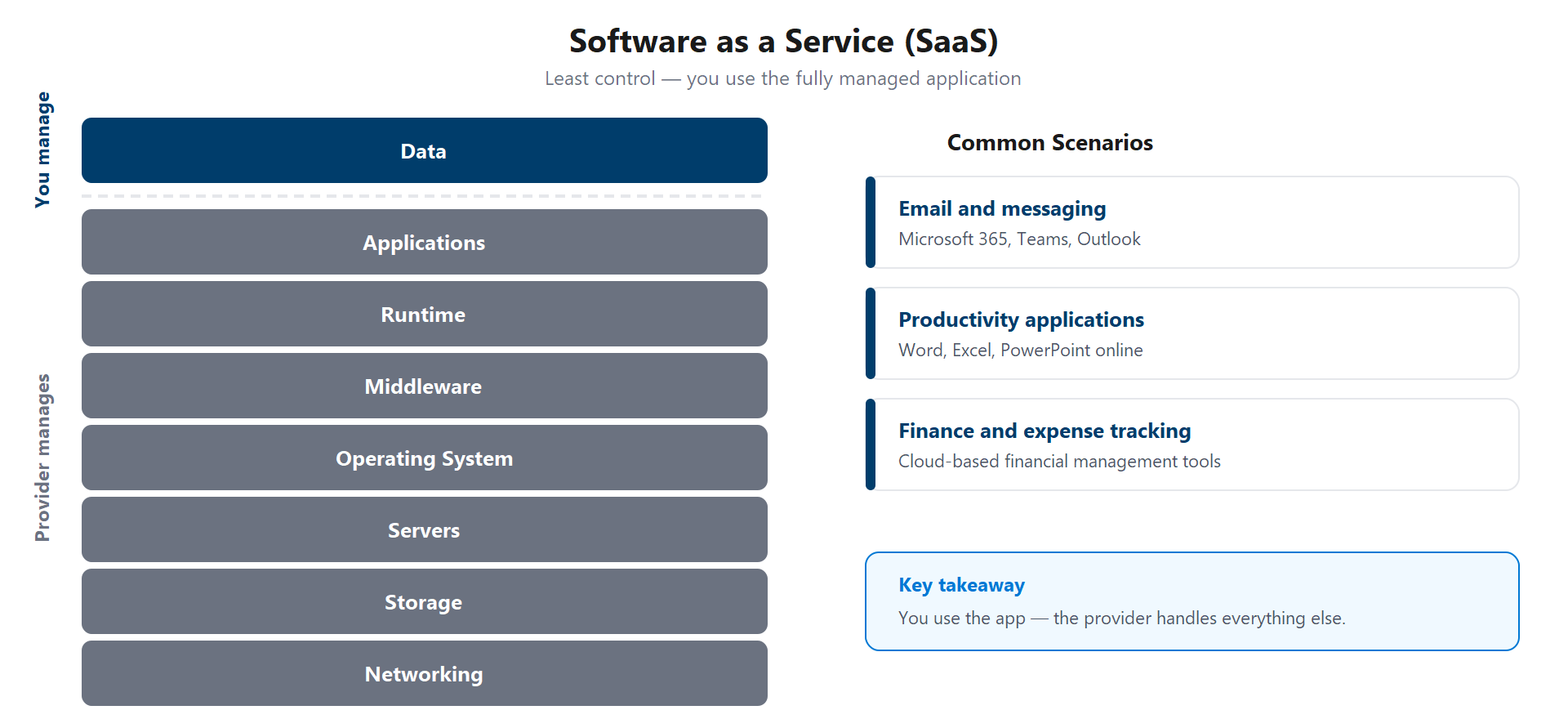
For example, a team using a SaaS collaboration platform can focus on user onboarding, access controls, and data governance while the provider handles infrastructure patching, application updates, and availability.
Scenarios
Common scenarios for SaaS include:
- Email and messaging.
- Productivity applications.
- Finance and expense tracking.