Describe Platform as a Service
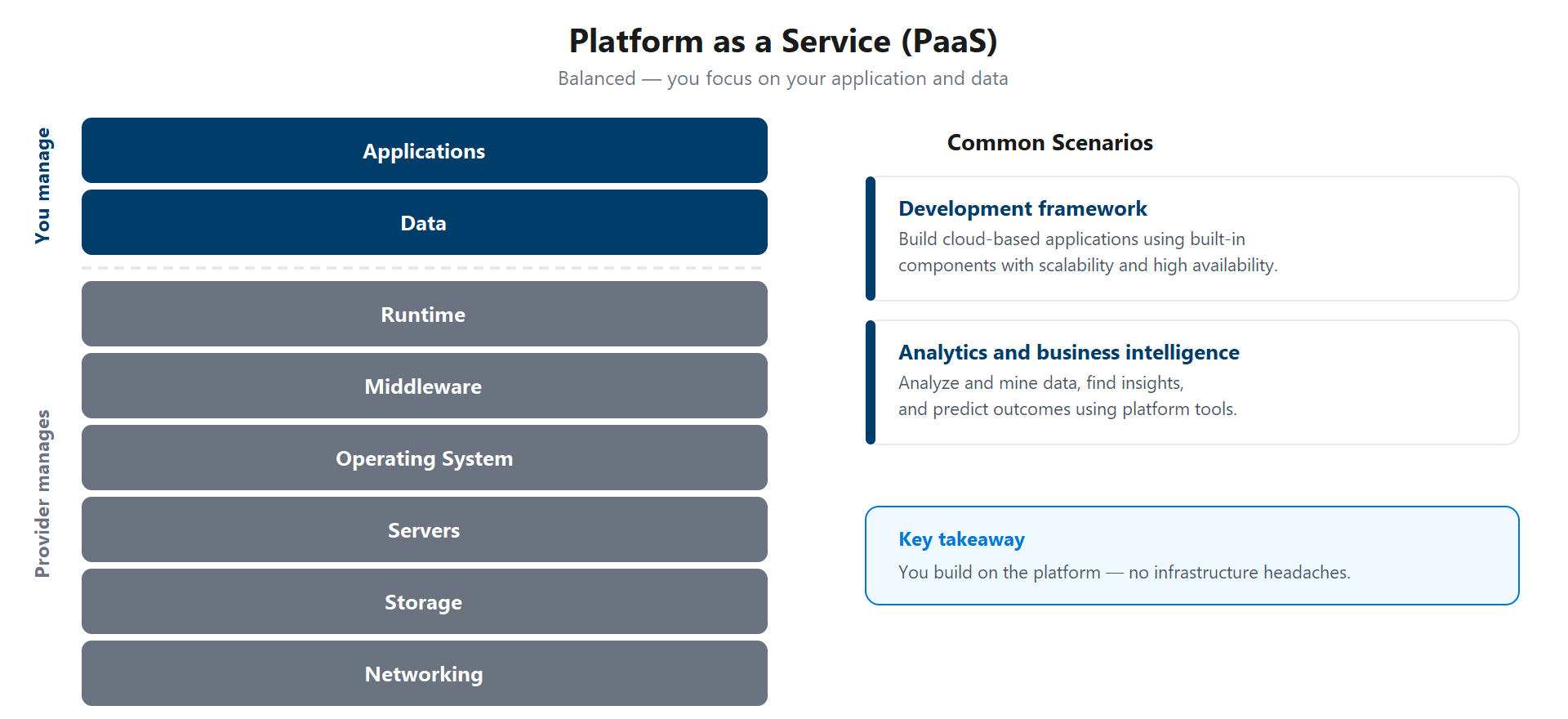
Platform as a service (PaaS) is a middle ground between renting space in a datacenter (infrastructure as a service) and paying for a complete and deployed solution (software as a service). In a PaaS environment, the cloud provider maintains the physical infrastructure, physical security, and connection to the internet. They also maintain the operating systems, middleware, development tools, and analytics services that make up a cloud solution. In a PaaS scenario, you don't have to worry about the licensing or patching for operating systems and databases.
PaaS is well suited to provide a complete development environment without the headache of maintaining all the development infrastructure.
Responsibility focus in PaaS
In PaaS, the cloud provider manages the physical infrastructure and platform components such as operating systems, middleware, and managed runtimes. You focus on your application code, data, and access controls. Depending on service configuration, some networking and application security settings are shared.
Scenarios
Common scenarios where PaaS might make sense include:
- Development framework: PaaS provides a framework that developers can build upon to develop or customize cloud-based applications. Developers can create applications using built-in software components. Cloud features such as scalability, high availability, and multitenant capability are included, reducing the amount of coding that developers must do.
- Analytics or business intelligence: Tools provided as a service with PaaS allow teams to analyze and mine their data, find insights and patterns, and predict outcomes to improve planning and operational decisions.