Describe the consumption-based model
Cloud computing operates on a consumption-based model. You pay for the IT resources you use, and nothing more. Instead of buying and maintaining your own datacenter infrastructure, you rent compute power and storage and release those resources when you're done.
In traditional IT budgeting, you may hear the terms capital expenditure (CapEx) and operational expenditure (OpEx). CapEx refers to up-front spending on physical infrastructure like servers, network hardware, and datacenter space. OpEx refers to ongoing spending on services over time. Because you pay for cloud services as you consume them, cloud computing is classified as an operational expense.
The consumption-based model offers several key benefits:
- No upfront costs for hardware or datacenter infrastructure.
- No need to purchase and manage capacity that may go underutilized.
- The ability to add resources when demand increases.
- The ability to release resources when demand decreases.
Capacity planning: traditional vs. cloud
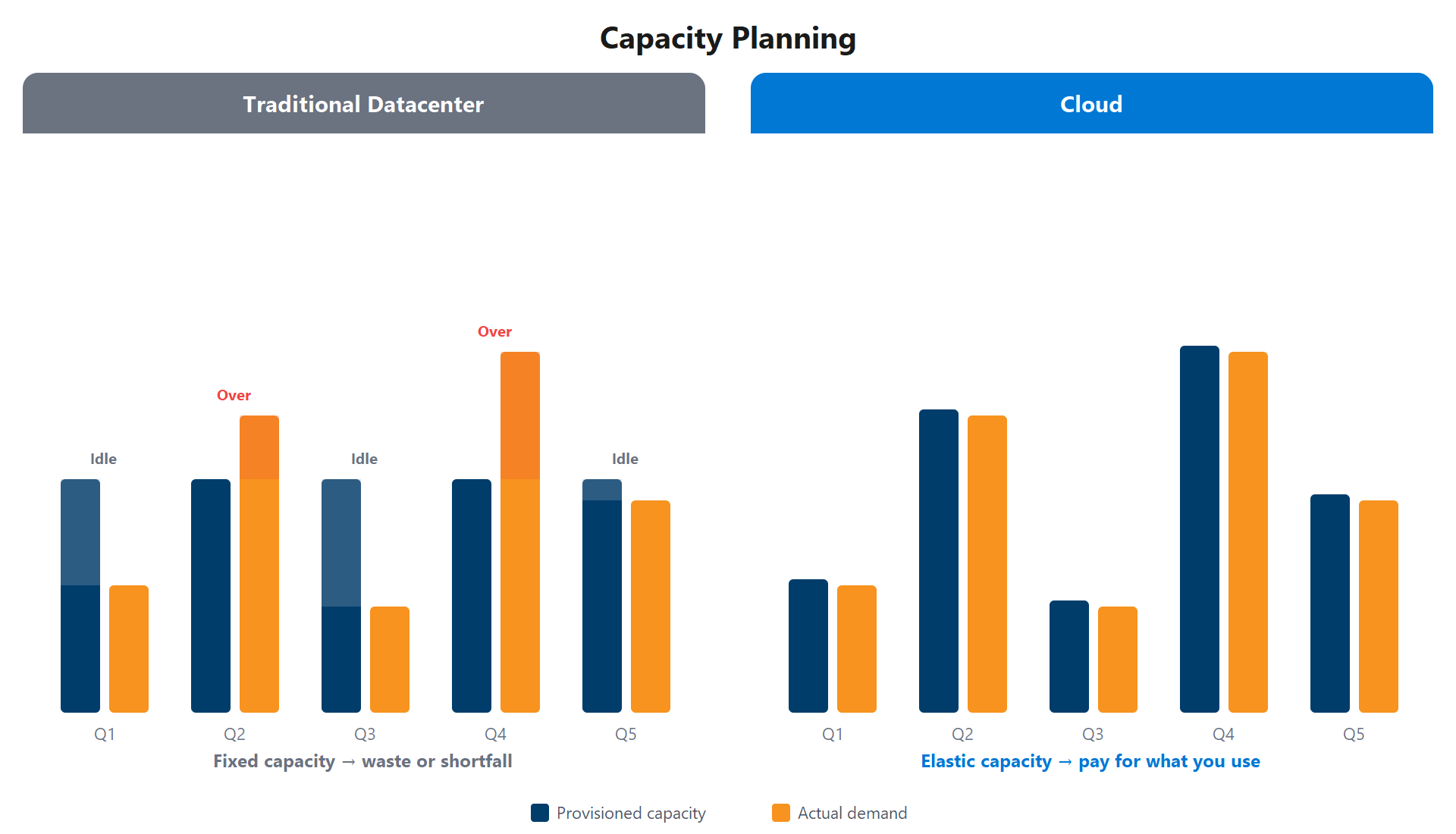
With a traditional datacenter, you estimate future resource needs in advance. Overestimate, and you overspend on infrastructure that sits idle. Underestimate, and your applications suffer degraded performance. Fixing the problem means ordering, installing, and provisioning additional hardware, power, and cooling.
In a cloud-based model, you adjust resources to match actual demand. Add virtual machines when you need more capacity; remove them when demand drops. You pay only for what you use, not for idle capacity. In practice, you can scale out during peak demand and scale back in when traffic subsides.
Cloud pricing
Cloud providers use a pay-as-you-go pricing model. You typically pay only for the services you consume, which helps you:
- Plan and manage operating costs.
- Run infrastructure more efficiently.
- Scale as workload needs change.
The cloud provider maintains the underlying infrastructure, including power, cooling, hardware, and networking, so you can focus on solving business problems and delivering new capabilities to your users.