Define cloud models
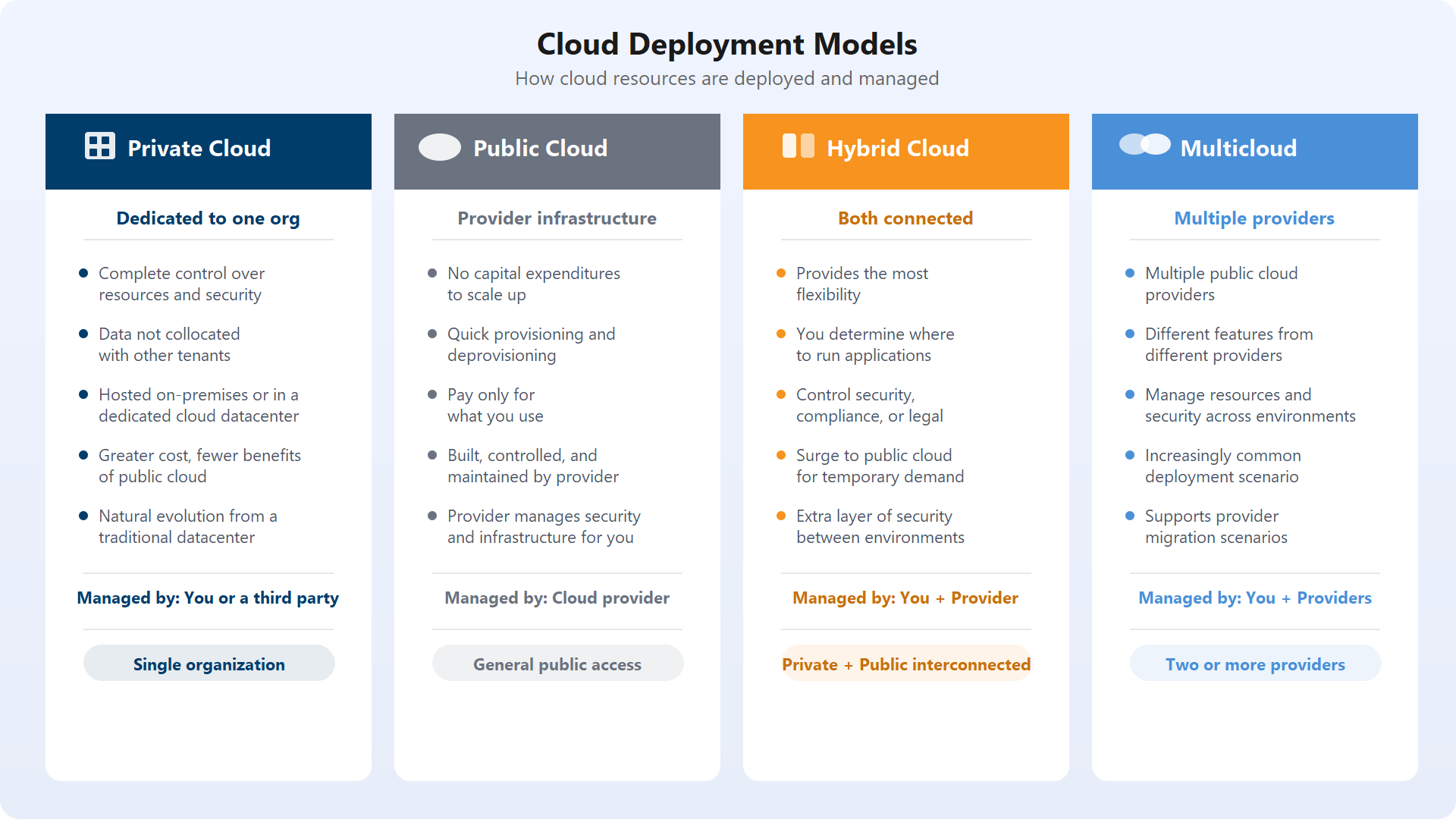
What are cloud models? The cloud models define the deployment type of cloud resources. The three main cloud models are: private, public, and hybrid.
Private cloud
A private cloud is a cloud environment used by a single entity. It evolved naturally from the traditional datacenter model, delivering IT services over the internet while keeping resources dedicated to one organization. Private cloud provides much greater control for your IT team. However, it also comes with greater cost and fewer of the benefits of a public cloud deployment. A private cloud may be hosted from your on-site datacenter, or in a dedicated datacenter offsite, potentially even by a third party.
Public cloud
A public cloud is built, controlled, and maintained by a third-party cloud provider. With a public cloud, anyone that wants to purchase cloud services can access and use resources. The general public availability is a key difference between public and private clouds.
Hybrid cloud
A hybrid cloud is a computing environment that uses both public and private clouds in an inter-connected environment. A hybrid cloud environment can be used to allow a private cloud to surge for increased, temporary demand by deploying public cloud resources. Hybrid cloud can be used to provide an extra layer of security. For example, users can flexibly choose which services to keep in public cloud and which to deploy to their private cloud infrastructure.
The following table highlights a few key comparative aspects between the cloud models.
| Public cloud | Private cloud | Hybrid cloud |
|---|---|---|
| No capital expenditures to scale up | You have complete control over resources and security | Provides the most flexibility |
| Applications can be quickly provisioned and deprovisioned | Data isn't collocated with other tenants' data | You determine where to run your applications |
| You pay only for what you use | Hardware must be purchased for startup and maintenance | You control security, compliance, or legal requirements |
| You don't have complete control over resources and security | You are responsible for hardware maintenance and updates |
Multicloud
A fourth, and increasingly likely scenario is a multicloud scenario. In a multicloud scenario, you use multiple public cloud providers. Maybe you use different features from different cloud providers. Or maybe you started your cloud journey with one provider and are in the process of migrating to a different provider. Regardless, in a multicloud environment you deal with two (or more) public cloud providers and manage resources and security in both environments.
Azure Arc
Azure Arc is a set of technologies that helps manage your cloud environment. Azure Arc can help manage your cloud environment whether it's a public cloud solely on Azure, a private cloud in your datacenter, a hybrid configuration, or even a multicloud environment running on multiple cloud providers at once.
Azure VMware Solution
What if you're already established with VMware in a private cloud environment but want to migrate to a public or hybrid cloud? Azure VMware Solution lets you run your VMware workloads in Azure with seamless integration and scalability.